
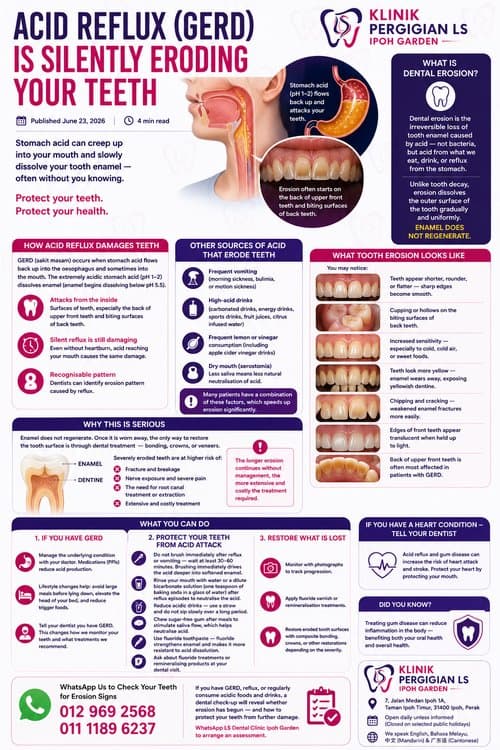
What Is Dental Erosion?
Dental erosion is the irreversible loss of tooth enamel caused by acid — not bacteria, but acid from what we eat, drink, or reflux from the stomach.
Unlike tooth decay (which starts as a hole), erosion dissolves the outer surface of the tooth gradually and uniformly. By the time most patients notice something is wrong, significant damage has already occurred.
How Does Acid Reflux Damage Teeth?
Gastroesophageal reflux disease (GERD) — known as sakit masam or acid reflux — happens when stomach acid flows back up into the oesophagus and sometimes into the mouth. Stomach acid has a pH of around 1–2, which is extremely corrosive to tooth enamel (enamel begins dissolving below pH 5.5).
Even silent reflux — where you do not feel the classic burning sensation but acid still reaches the mouth — causes the same damage.
The acid attacks your teeth from the inside surfaces (especially the back of the upper front teeth) and the biting surfaces of the back teeth — a pattern that dentists can recognise.
Other Sources of Acid That Erode Teeth
GERD is not the only cause. Other common contributors include:
- Frequent vomiting — from morning sickness, bulimia, or motion sickness
- High-acid drinks — carbonated drinks, energy drinks, sports drinks, fruit juices, and citrus-infused water
- Frequent lemon or vinegar consumption — including apple cider vinegar drinks
- Dry mouth — less saliva means less natural neutralisation of acid
Many patients have a combination of these factors, which speeds up erosion significantly.
What Tooth Erosion Looks Like
You may notice:
- Teeth appear shorter, rounder, or flatter — the sharp edges of front teeth become smooth
- Cupping or hollows on the biting surfaces of back teeth
- Increased sensitivity — especially to cold drinks, cold air, or sweet foods
- Teeth that look more yellow — as the thin white enamel wears away, the yellowish dentine underneath shows through
- Chipping and cracking — weakened enamel fractures more easily under biting force
- The edges of front teeth appear translucent when held up to light
The back of the upper front teeth is often the most affected area in patients with GERD, because this is where refluxed acid pools.
Why This Is Serious
Enamel does not regenerate. Once it is worn away, the only way to restore the tooth surface is through dental treatment — bonding, crowns, or veneers. The longer erosion continues without management, the more extensive and costly the treatment required.
Beyond aesthetics and sensitivity, severely eroded teeth are at higher risk of:
- Fracture and breakage
- Nerve exposure and severe pain
- The need for root canal treatment or extraction
What You Can Do
If you have GERD
The most important step is managing the underlying condition with your doctor. Proton pump inhibitors (PPIs) and other medications reduce acid production. Lifestyle changes also help: avoiding large meals before lying down, elevating the head of your bed, and reducing trigger foods.
Tell your dentist you have GERD. This changes how we monitor your teeth and what treatments we recommend.
Protect your teeth from acid attack
- Do not brush immediately after reflux or vomiting — wait at least 30–60 minutes. Brushing immediately drives the acid deeper into softened enamel
- Rinse your mouth with water or a dilute bicarbonate solution (one teaspoon of baking soda in a glass of water) after reflux episodes to neutralise the acid
- Reduce acidic drinks — if you consume them, use a straw and do not sip slowly over a long period
- Chew sugar-free gum after meals to stimulate saliva flow, which helps neutralise acid
- Use fluoride toothpaste — fluoride strengthens enamel and makes it more resistant to acid dissolution
- Ask about fluoride treatments or remineralising products at your dental visit
Restore what is lost
If erosion is already present, the dentist can:
- Monitor with photographs to track progression
- Apply fluoride varnish or remineralisation treatments
- Restore eroded tooth surfaces with composite bonding, crowns, or other restorations depending on the severity
WhatsApp Us to Check Your Teeth for Erosion Signs
If you have GERD, reflux, or regularly consume acidic foods and drinks, a dental check-up will reveal whether erosion has begun — and how to protect your teeth from further damage. WhatsApp LS Dental Clinic Ipoh Garden to arrange an assessment.
Key Research References
- Savarino E et al. (2021). Gastro-oesophageal reflux disease. Nature Reviews Disease Primers. Clinical consensus documents confirm dental erosion as an extraoesophageal manifestation of GERD.
- Moazzez R, Bartlett D. (2014). Intrinsic causes of erosion. Monographs in Oral Science, 25, 180–196 — foundational reference on GERD-linked enamel dissolution patterns.
- Schlueter N et al. (2020). Dental erosion — an update on aetiology, diagnosis and outcomes. Dental Update. Describes the characteristic erosion pattern on the palatal surfaces of upper anterior teeth in GERD patients.