
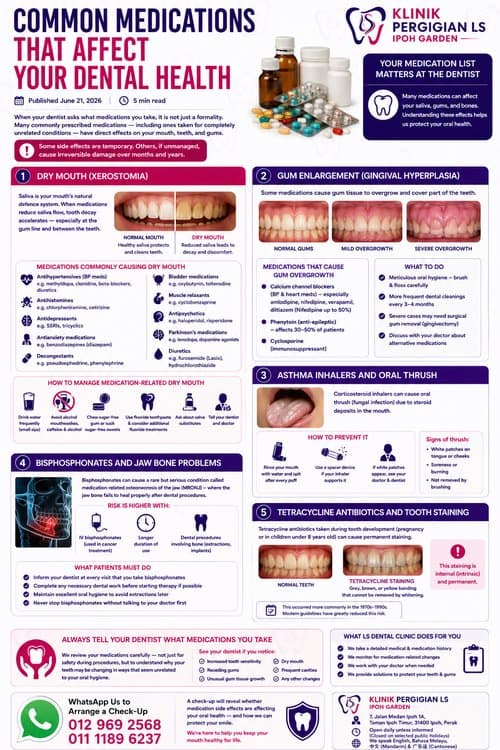
Your Medication List Matters at the Dentist
When your dentist asks what medications you take, it is not just a formality. Many commonly prescribed medications — including ones taken for completely unrelated conditions — have direct effects on your mouth, teeth, and gums.
Some side effects are temporary. Others, if unmanaged, cause irreversible damage over months and years.
1. Dry Mouth (Xerostomia)
The most widespread medication-related dental problem.
Saliva is your mouth's natural defence system. It neutralises acid, washes away food particles and bacteria, provides minerals that repair early enamel damage, and contains antibodies that fight infection.
When medications reduce saliva flow, tooth decay accelerates dramatically — especially at the gum line and between the teeth. Patients who never had a single cavity can develop multiple decayed teeth within a year of starting a medication that causes dry mouth.
Medications commonly causing dry mouth:
- Antihypertensives (blood pressure medications) — especially older types like methyldopa, clonidine, beta-blockers, and diuretics
- Antihistamines — including common allergy medications like chlorpheniramine and cetirizine
- Antidepressants — SSRIs (fluoxetine, sertraline), tricyclics (amitriptyline), and others
- Antianxiety medications — benzodiazepines like diazepam (Valium)
- Decongestants — pseudoephedrine and phenylephrine found in many cold medications
- Bladder medications — oxybutynin and tolterodine for overactive bladder
- Muscle relaxants — cyclobenzaprine and similar agents
- Antipsychotics — haloperidol, risperidone, and others
- Parkinson's disease medications — levodopa and dopamine agonists
- Diuretics — furosemide (Lasix) and hydrochlorothiazide
How to manage medication-related dry mouth:
- Drink water frequently throughout the day — small sips, not large amounts at once
- Avoid alcohol-containing mouthwashes, caffeinated drinks, and alcohol, which all worsen dryness
- Chew sugar-free gum or suck sugar-free sweets to stimulate what saliva you have
- Use a fluoride toothpaste and consider additional fluoride treatments — your risk of decay is elevated, so protecting enamel is critical
- Ask your dentist about saliva substitutes — prescription or over-the-counter products that coat the mouth and provide some lubrication
- Tell your dentist and doctor — sometimes an alternative medication with fewer oral side effects is available
2. Gum Enlargement (Gingival Hyperplasia)
Some medications cause the gum tissue to overgrow and cover part of the teeth — a condition called drug-induced gingival overgrowth or hyperplasia.
The gum tissue does not become cancerous, but it:
- Makes it extremely difficult to clean the teeth properly
- Traps food and bacteria, leading to severe inflammation
- Can completely cover the tooth surface in serious cases
- Is unattractive and can affect speech if severe
Medications that cause gum overgrowth:
- Calcium channel blockers (used for blood pressure and heart conditions) — especially amlodipine, nifedipine, verapamil, and diltiazem. Nifedipine has the highest reported rate of gum overgrowth, affecting up to 50% of patients
- Phenytoin (an anti-epileptic / seizure medication) — affects 30–50% of patients
- Cyclosporine (an immunosuppressant used after organ transplants)
What to do:
- Meticulous oral hygiene — brushing and flossing very carefully can reduce the severity significantly, even if it cannot eliminate the problem entirely
- More frequent dental cleanings — every 3–4 months instead of 6
- In severe cases, a gingivectomy (surgical removal of excess gum tissue) may be needed — but the overgrowth often returns while the medication continues
- Discuss with your doctor whether an alternative medication is feasible
3. Asthma Inhalers and Oral Thrush
Corticosteroid inhalers (such as fluticasone, budesonide, and beclomethasone) are essential for asthma and COPD management. However, corticosteroid powder that deposits in the mouth can suppress the local immune response, allowing Candida (a fungal organism naturally present in the mouth) to overgrow.
This causes oral thrush — white patches on the tongue and inner cheeks that can be painful and are not removed by brushing.
How to prevent it:
- Rinse your mouth with water and spit after every puff of the inhaler — this removes most of the deposited steroid from the mouth
- Use a spacer device if your inhaler supports it — this improves medication delivery to the lungs and reduces oral deposition
- If white patches appear, see both your doctor (for antifungal treatment) and your dentist
4. Bisphosphonates and Jaw Bone Problems
Bisphosphonates — medications taken for osteoporosis, bone cancer, and Paget's disease (such as alendronate/Fosamax, zoledronic acid, and denosumab) — can cause a rare but serious complication called medication-related osteonecrosis of the jaw (MRONJ).
In MRONJ, bone in the jaw fails to heal properly after dental procedures — particularly tooth extractions and implant placement — leading to exposed bone, infection, and prolonged pain.
Risk is higher with:
- Intravenous bisphosphonates (used in cancer treatment) vs. oral tablets (used in osteoporosis)
- Longer duration of use
- Dental procedures involving bone (extractions, implants)
What patients on bisphosphonates must do:
- Inform your dentist at every visit that you take bisphosphonates — this is critical
- Complete any necessary tooth extractions or surgical dental work before starting bisphosphonate therapy if possible
- While on bisphosphonates, maintain excellent oral hygiene to avoid needing extractions later
- Never stop bisphosphonates without talking to your doctor first
5. Tetracycline Antibiotics and Permanent Tooth Staining
Tetracycline antibiotics (doxycycline, minocycline) taken during tooth development — during pregnancy or in children under 8 years old — can be permanently incorporated into developing tooth enamel, causing grey, brown, or yellow banding or discolouration across the entire tooth. This staining is internal (intrinsic) and cannot be removed with whitening.
Newer formulations and medical guidelines have greatly reduced this occurrence, but patients who received tetracyclines in childhood in the 1970s–1990s often have this staining.
Always Tell Your Dentist What Medications You Take
At LS Dental Clinic Ipoh Garden, we review your medications carefully — not just for safety during procedures, but to understand why your teeth and gums may be changing in ways that seem unrelated to your oral hygiene.
If you are taking any chronic medication and have noticed increased tooth sensitivity, receding gums, unusual gum tissue growth, dry mouth, or frequent cavities, it may be connected to your medication.
WhatsApp us to arrange a check-up. We will assess your current dental condition and work with the effects of your medication to protect your teeth and gums as effectively as possible.