
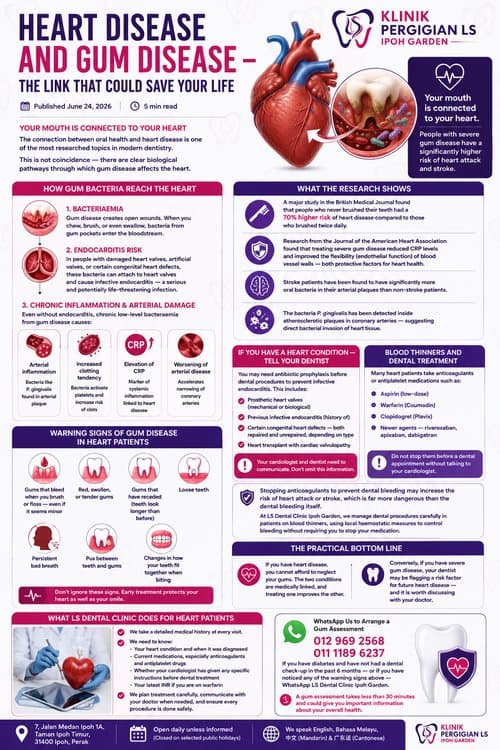
Your Mouth Is Connected to Your Heart
The connection between oral health and heart disease is one of the most researched topics in modern dentistry. While scientists continue to study the exact mechanisms, multiple large studies have found that people with severe gum disease (periodontitis) have a significantly higher risk of heart attack and stroke compared to those with healthy gums.
This is not coincidence — there are clear biological pathways through which gum disease affects the heart.
How Gum Bacteria Reach the Heart
The gums of a person with periodontitis are essentially open wounds lined with infected tissue. Every time they chew, brush, or even swallow, bacteria from the gum pockets enter the bloodstream — a process called bacteraemia.
In most people, the immune system clears these bacteria quickly. But in patients with damaged heart valves, artificial heart valves, or certain congenital heart defects, these bacteria can attach to the heart valves and cause infective endocarditis — a serious and potentially life-threatening infection of the inner lining of the heart.
Even without endocarditis, the chronic low-level bacteraemia from gum disease causes:
- Arterial inflammation — the same bacteria found in gum pockets (particularly Porphyromonas gingivalis and Streptococcus species) have been found inside arterial plaque deposits
- Increased clotting tendency — gum disease bacteria activate platelets and increase the likelihood of blood clots
- Elevation of C-reactive protein (CRP) — a marker of systemic inflammation linked to cardiovascular events
- Worsening of existing arterial disease — accelerating narrowing of the coronary arteries
What the Research Shows
- A major study published in the British Medical Journal found that people who never brushed their teeth had a 70% higher risk of heart disease compared to those who brushed twice daily
- Research from the Journal of the American Heart Association found that treating severe gum disease reduced CRP levels and improved the flexibility (endothelial function) of blood vessel walls — both protective factors for heart health
- Stroke patients have been found to have significantly more oral bacteria in their arterial plaques than non-stroke patients
- The bacteria P. gingivalis has been detected inside atherosclerotic plaques in coronary arteries — suggesting direct bacterial invasion of heart tissue
If You Have a Heart Condition — Tell Your Dentist
This is critical. Certain heart conditions require antibiotic prophylaxis before dental procedures to prevent infective endocarditis. These include:
- Prosthetic heart valves (mechanical or biological)
- Previous infective endocarditis (history of)
- Certain congenital heart defects — both repaired and unrepaired, depending on type
- Heart transplant with cardiac valvulopathy
Your cardiologist and dentist need to communicate. If you have any of the above conditions and need a dental extraction or procedure that involves the gum tissue, you will need antibiotics beforehand. Do not omit this information from your dentist.
Blood Thinners and Dental Treatment
Many heart patients take anticoagulants or antiplatelet medications such as:
- Aspirin (low-dose)
- Warfarin (Coumadin)
- Clopidogrel (Plavix)
- Newer agents — rivaroxaban, apixaban, dabigatran
These medications affect how your blood clots after dental procedures. Do not stop them before a dental appointment without talking to your cardiologist — stopping anticoagulants to prevent dental bleeding may increase the risk of a heart attack or stroke, which is far more dangerous than the dental bleeding itself.
At LS Dental Clinic Ipoh Garden, we manage dental procedures carefully in patients on blood thinners, using local haemostatic measures to control bleeding without requiring you to stop your medication.
Warning Signs of Gum Disease in Heart Patients
Do not ignore these:
- Gums that bleed when you brush or floss — even if it seems minor
- Red, swollen, or tender gums
- Gums that have receded (teeth look longer than before)
- Loose teeth
- Persistent bad breath
- Pus between teeth and gums
- Changes in how your teeth fit together when biting
The Practical Bottom Line
If you have heart disease, you cannot afford to neglect your gums. The two conditions are medically linked, and treating one improves the other.
Conversely, if you have severe gum disease, your dentist may be flagging a risk factor for future heart disease — and it is worth discussing with your doctor.
What LS Dental Clinic Does for Heart Patients
We take a detailed medical history at every visit. We need to know:
- Your heart condition and when it was diagnosed
- Current medications, especially anticoagulants and antiplatelet drugs
- Whether your cardiologist has given any specific instructions before dental treatment
- Your latest INR if you are on warfarin
We plan treatment carefully, communicate with your doctor when needed, and ensure every procedure is done safely.
WhatsApp LS Dental Clinic Ipoh Garden to arrange a gum assessment. Healthy gums are not just good for your smile — they are good for your heart.
Key Research References
- Gao X et al. (2025). The Systemic Link Between Oral Health and Cardiovascular Disease: Contemporary Evidence, Mechanisms, and Risk Factor Implications. Diseases, 13(11), 354. PMC Full Text
- Larvin H et al. (2023). Periodontal disease and subsequent risk of cardiovascular outcome and all-cause mortality: A meta-analysis of prospective studies. PLOS ONE. PMC Full Text — 39 cohort studies, 4+ million participants
- Alfakry H et al. (2024). Does Periodontitis Increase the Risk for Future Cardiovascular Events? Long-Term Follow-Up of the PAROKRANK Study. Journal of the American Heart Association. PMC Full Text
- American Heart Association (2025). Treating Gum Disease Improves Markers Associated With Heart Disease Risk — Scientific Statement update. Medscape Summary