
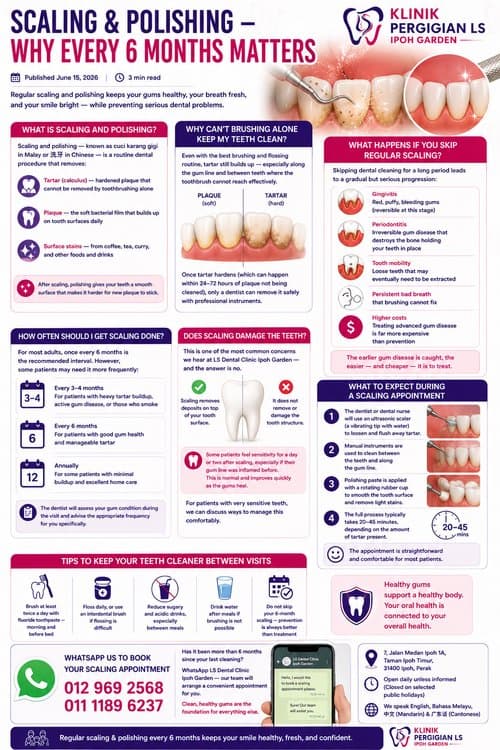
What Is Scaling and Polishing?
Scaling and polishing — known as cuci karang gigi in Malay or 洗牙 in Chinese — is a routine dental procedure that removes:
- Tartar (calculus) — hardened plaque that cannot be removed by toothbrushing alone
- Plaque — the soft bacterial film that builds up on tooth surfaces daily
- Surface stains — from coffee, tea, curry, and other foods and drinks
After scaling, polishing gives your teeth a smooth surface that makes it harder for new plaque to stick.
Why Can't Brushing Alone Keep My Teeth Clean?
Even with the best brushing and flossing routine, tartar still builds up — especially along the gum line and between teeth where the toothbrush cannot reach effectively. Once tartar hardens (which can happen within 24–72 hours of plaque not being cleaned), only a dentist can remove it safely with professional instruments.
What Happens If You Skip Regular Scaling?
Skipping dental cleaning for a long period leads to a gradual but serious progression:
- Gingivitis — red, puffy, bleeding gums (reversible at this stage)
- Periodontitis — irreversible gum disease that destroys the bone holding your teeth in place
- Tooth mobility — loose teeth that may eventually need to be extracted
- Persistent bad breath that brushing cannot fix
- Higher costs — treating advanced gum disease is far more expensive than prevention
The earlier gum disease is caught, the easier — and cheaper — it is to treat.
How Often Should I Get Scaling Done?
For most adults, once every 6 months is the recommended interval. However, some patients may need it more frequently:
- Every 3–4 months — for patients with heavy tartar buildup, active gum disease, or those who smoke
- Every 6 months — for patients with good gum health and manageable tartar
- Annually — for some patients with minimal buildup and excellent home care
The dentist will assess your gum condition during the visit and advise the appropriate frequency for you specifically.
Does Scaling Damage the Teeth?
This is one of the most common concerns we hear at LS Dental Clinic Ipoh Garden — and the answer is no. Scaling removes deposits on top of your tooth surface, not the tooth structure itself.
Some patients feel sensitivity for a day or two after scaling, especially if their gum line was inflamed before. This is normal and improves quickly as the gums heal. For patients with very sensitive teeth, we can discuss ways to manage this comfortably.
What to Expect During a Scaling Appointment
- The dentist or dental nurse will use an ultrasonic scaler (a vibrating tip with water) to loosen and flush away tartar
- Manual instruments are used to clean between the teeth and along the gum line
- Polishing paste is applied with a rotating rubber cup to smooth the tooth surface and remove light stains
- The full process typically takes 20–45 minutes, depending on the amount of tartar present
The appointment is straightforward and comfortable for most patients.
Tips to Keep Your Teeth Cleaner Between Visits
- Brush at least twice a day with fluoride toothpaste — morning and before bed
- Floss daily, or use an interdental brush if flossing is difficult
- Reduce sugary and acidic drinks, especially between meals
- Drink water after meals if brushing is not possible
- Do not skip your 6-month scaling — prevention is always better than treatment
WhatsApp Us to Book Your Scaling Appointment
Has it been more than 6 months since your last cleaning? WhatsApp LS Dental Clinic Ipoh Garden — our team will arrange a convenient appointment for you. Clean, healthy gums are the foundation for everything else.