What Is Sleep Apnea?
Obstructive sleep apnea (OSA) is a condition where the throat muscles relax during sleep, causing the airway to partially or completely collapse. Breathing stops repeatedly throughout the night — sometimes hundreds of times — often without the person knowing.
Sleep apnea is significantly underdiagnosed in Malaysia. Many patients live with it for years, attributing their symptoms to stress or poor sleep habits.
How Sleep Apnea Destroys Teeth
The connection between sleep apnea and dental damage is strong — and dentists often spot the signs before patients have been diagnosed with OSA.
1. Teeth Grinding (Bruxism)
The most direct link. When the airway is blocked during sleep, the brain triggers a survival response — the jaw clenches and the teeth grind as the body tries to move the jaw forward to reopen the airway.
This grinding and clenching during sleep (sleep bruxism) causes:
- Severe flattening and wearing down of the biting surfaces of teeth
- Chipping and fracturing of teeth, especially the front teeth
- Cracked teeth — sometimes down to the root, requiring extraction
- Destruction of dental restorations — fillings, crowns, and veneers break prematurely
- Jaw joint pain (TMJ disorder), headaches, and neck pain
Many patients do not know they grind their teeth at night until a dentist points out the wear pattern.
2. Dry Mouth and Accelerated Tooth Decay
Sleep apnea patients almost universally breathe through their mouths during sleep, because mouth breathing is the body's attempt to maintain airflow when the nasal passage or throat is obstructed.
Mouth breathing overnight desiccates the mouth completely. Saliva — which normally protects teeth by neutralising acid and washing away bacteria — is absent. The result:
- Rapid buildup of plaque and tartar
- Accelerated decay, particularly at the gum line
- Gum inflammation and bleeding
- Persistent morning bad breath (halitosis)
3. Acid Reflux During Sleep
Sleep apnea causes pressure changes in the chest that can pull stomach acid up into the oesophagus. Many OSA patients have silent nocturnal acid reflux — acid reaching the mouth while asleep — which gradually erodes tooth enamel from the inside surfaces.
4. TMJ Disorder
The repetitive jaw clenching that occurs with sleep apnea strains the temporomandibular joint (TMJ) — the hinge connecting your jaw to your skull. Over time this leads to:
- Jaw pain, especially in the morning
- Clicking or popping sounds when opening the mouth
- Difficulty opening wide
- Ear pain and headaches
Signs Your Dentist Looks For
At a dental check-up, we may notice:
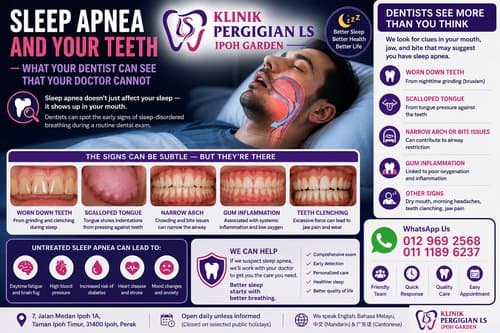
- Flat, worn-down biting surfaces — especially on the back teeth
- Chipped front teeth edges — the edges should be sharp; worn edges suggest grinding
- Scalloped tongue — indentations on the sides of the tongue from pressing against the teeth during sleep, associated with airway obstruction
- Enlarged tonsils or tongue — visible during oral examination
- Erosion on the inner surfaces of the upper front teeth — suggests acid reflux
- Jaw muscle tenderness — the masseter muscle (behind the cheek) becomes enlarged with chronic clenching
What Your Dentist Can Do
Night Guard (Occlusal Splint)
A custom-fitted night guard covers the teeth and absorbs the forces of grinding, protecting tooth surfaces from wear. It does not treat sleep apnea itself, but it protects your teeth while other management is in place.
Mandibular Advancement Device (MAD)
For patients with mild-to-moderate sleep apnea who cannot tolerate a CPAP machine, a dentist can fabricate a custom oral appliance that holds the lower jaw slightly forward during sleep, keeping the airway open. This is a recognised, evidence-based treatment for mild-to-moderate OSA.
Referral for Sleep Study
If we identify signs consistent with sleep apnea, we can recommend you see a sleep physician for a proper sleep study (polysomnography) to confirm the diagnosis and determine severity.
Signs You May Have Sleep Apnea
Talk to your doctor if you experience:
- Loud, frequent snoring — especially if others have heard you stop breathing
- Waking up gasping or choking
- Morning headaches most days
- Waking up unrefreshed despite a full night's sleep
- Excessive daytime sleepiness — falling asleep while watching TV, reading, or driving
- Difficulty concentrating or memory problems
- Irritability and mood changes
- Frequent nighttime urination
High-risk groups include overweight individuals, those with a large neck circumference, men over 40, and patients with a small lower jaw or large tongue.
The Takeaway
Sleep apnea, teeth grinding, dry mouth, and acid reflux are all connected. If your dentist points out wear on your teeth that you cannot explain — take it seriously. It may not just be a dental problem.
WhatsApp LS Dental Clinic Ipoh Garden if you have been told you snore heavily, grind your teeth, or wake up with jaw pain and headaches. We will examine your teeth, discuss your symptoms, and guide you on the right next step.
Key Research References
- Bertoli E et al. (2025). Relationship Between Bruxism and Obstructive Sleep Apnea: A Systematic Review of the Literature. Journal of Clinical Medicine, 14(14), 5013. PMC Full Text
- Manfredini D et al. (2024). Sleep bruxism is highly prevalent in adults with obstructive sleep apnea: a large-scale polysomnographic study. Journal of Clinical Sleep Medicine. JCSM
- Hosoya H et al. (2023). Prevalence of bruxism in obstructive sleep apnea syndrome (OSAS) patients: A systematic review conducted according to PRISMA guidelines. PubMed. PubMed
- Dal Fabbro C et al. (2025). Understanding the clinical management of co-occurring sleep-related bruxism and obstructive sleep apnea in adults. Journal of Prosthodontics. Wiley