
3D CBCT X-Ray
See bone, nerves, and roots in full 3D — for safer, more precise treatment planning.
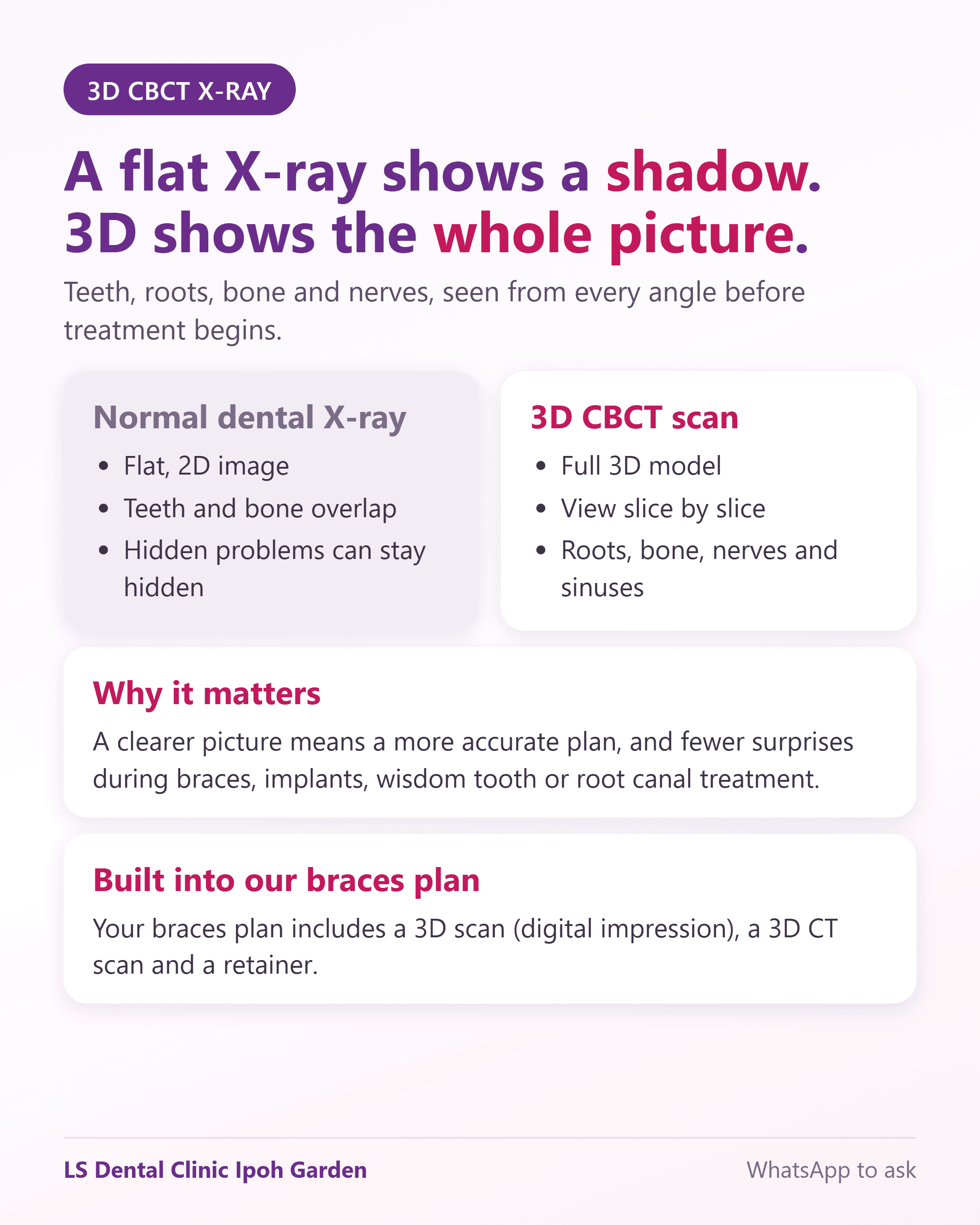
A CBCT (Cone Beam Computed Tomography) scan is a 3D X-ray that captures a complete, three-dimensional image of your teeth, jawbone, nerve canals, sinuses, and surrounding structures in a single scan. Unlike conventional 2D dental X-rays such as OPG (panoramic) or periapical films, which produce a flat image, CBCT allows the dentist to view your anatomy from every angle and at any depth. This level of detail is critical for safe implant placement, wisdom tooth assessment, root canal planning, and other procedures where the relationship between teeth, bone, and nerves must be precisely understood before treatment begins.
Signs You May Need This Treatment
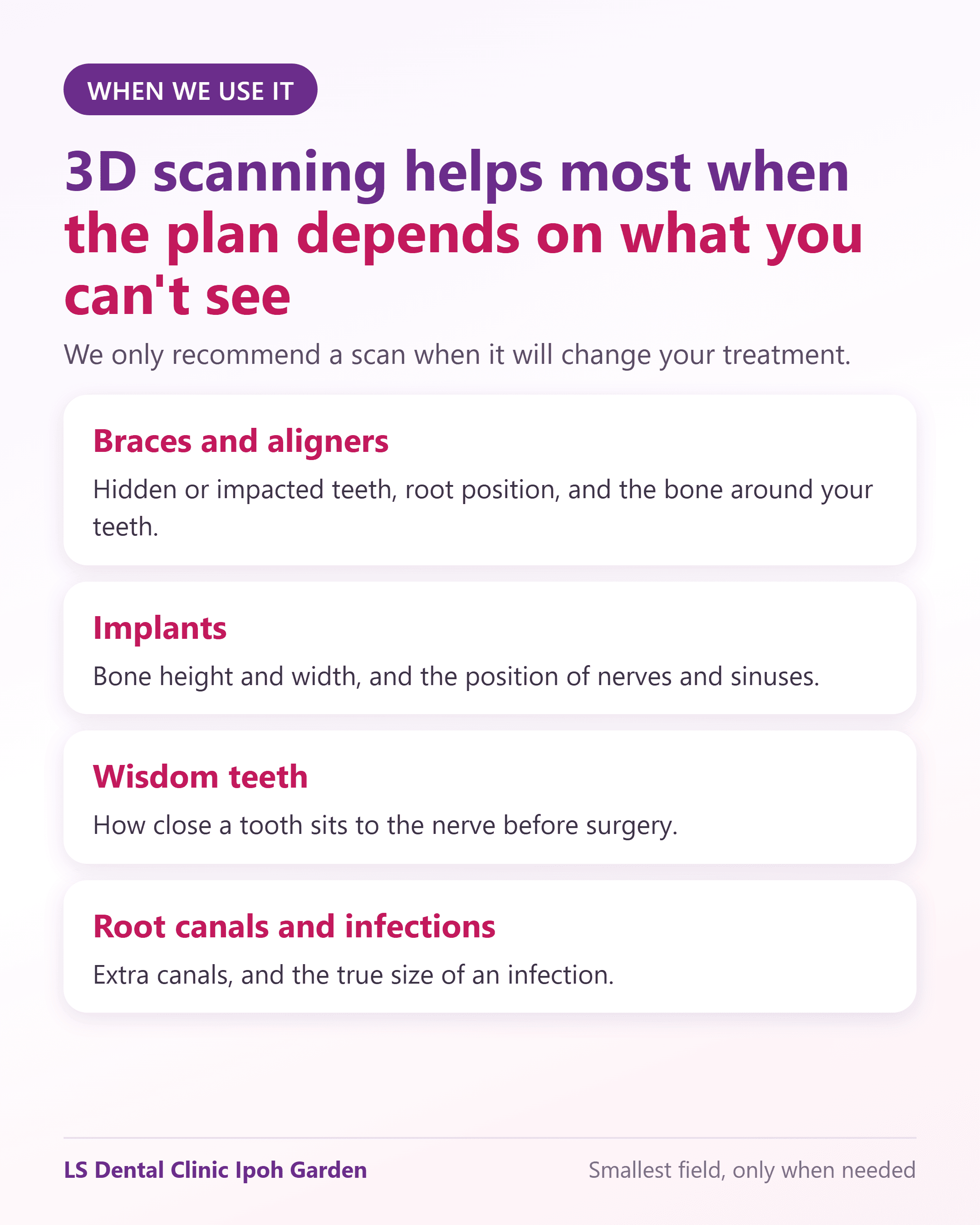
- 1You are being assessed for dental implants
- 2You have a complex or impacted wisdom tooth requiring surgical assessment
- 3You need root canal treatment on a tooth with complex or unclear root anatomy
- 4The dentist needs to assess bone volume or bone quality before a procedure
- 5You have a suspected cyst, lesion, or pathology that needs 3D assessment
- 6Orthodontic planning requires accurate 3D skeletal and tooth position data
What Happens During Your Visit
Preparation
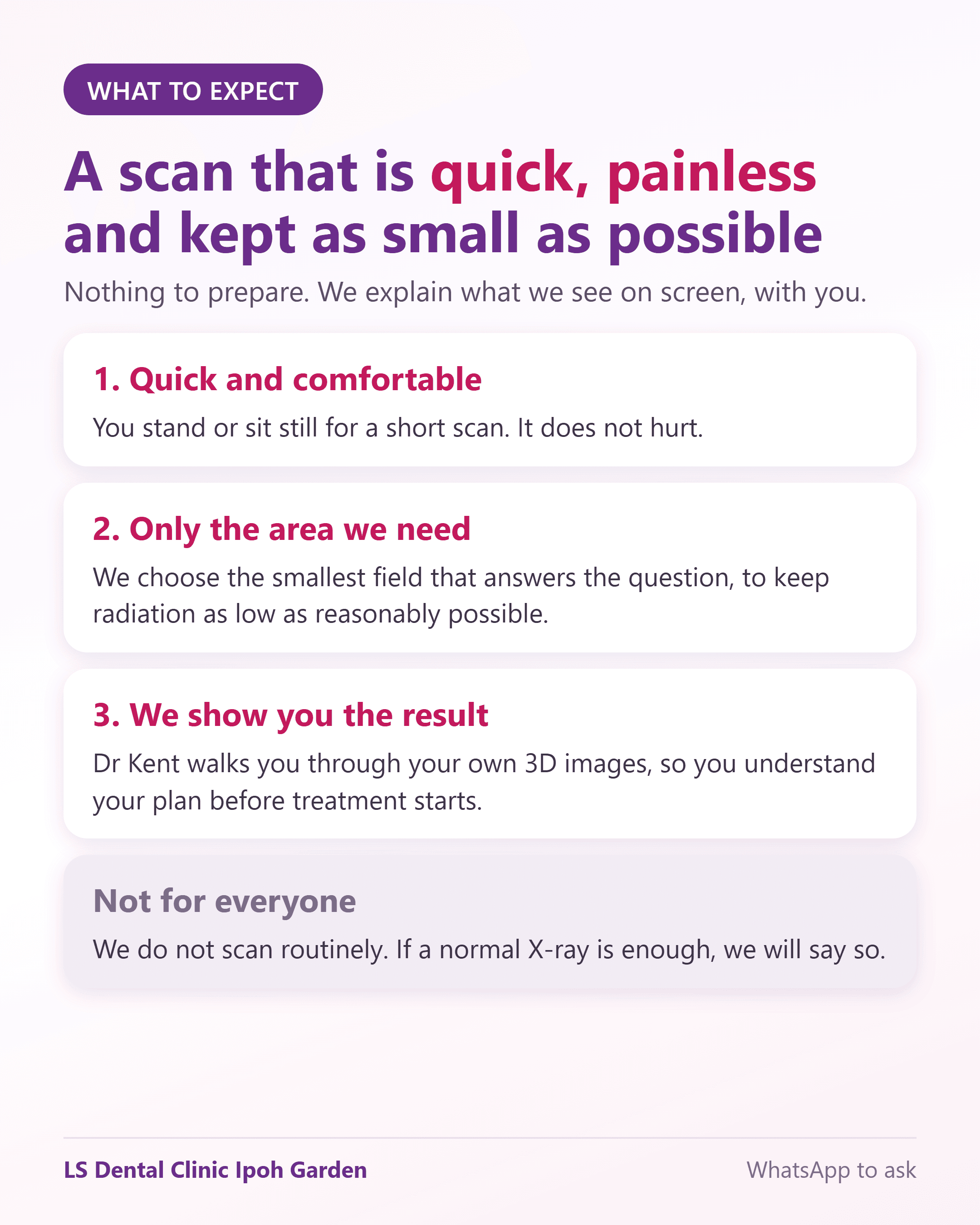
You will be asked to remove any metal jewellery, glasses, or removable dental appliances before the scan. No special preparation or fasting is required. The scan takes only 10–20 seconds.
Positioning
You will be seated or stand in the CBCT unit with your head positioned within the scanner. A chin rest and head supports hold your head still during the scan to ensure a sharp image.
Scanning
The scanner arm rotates around your head once, capturing hundreds of images from multiple angles in 10–20 seconds. You simply hold still and breathe normally.
3D Reconstruction & Review
The images are processed into a full 3D volumetric model. The dentist can navigate through cross-sections in all planes — horizontal, vertical, and oblique — to measure bone, locate nerve canals, assess root positions, and plan treatment precisely.
Benefits of This Treatment
- Full 3D view of teeth, bone, nerve canals, and sinuses — not possible with 2D X-rays
- Precise bone volume and density measurement for safe implant planning
- Accurate nerve canal location before wisdom tooth surgery — reduces risk of nerve injury
- Identifies complex root morphology before root canal treatment
- Detects cysts, lesions, or abnormalities that may be hidden on a 2D X-ray
- Enables accurate digital treatment planning — the dentist can virtually place an implant before the procedure
- Lower radiation dose than a medical CT scan while providing far more information than conventional dental X-rays
Who May Be Suitable
- ✓Patients being assessed for dental implants — bone volume and nerve position must be confirmed
- ✓Patients with impacted, deeply positioned, or complex wisdom teeth
- ✓Patients needing root canal treatment on teeth with difficult or unclear root anatomy
- ✓Orthodontic patients requiring skeletal assessment
- ✓Patients with suspected pathology — cysts, lesions, or abnormalities requiring 3D evaluation
May Not Be Suitable If:
- ⚠Pregnant women — as with all X-rays, CBCT should be avoided unless clinically necessary. Inform the dentist if you are or may be pregnant.
- ⚠Not every patient or procedure requires CBCT — the dentist will recommend it only when the clinical benefit justifies the scan
Need advice for 3D CBCT X-Ray?
Every patient's condition is different. The dentist will check your teeth and gums before advising the most suitable treatment option. You may WhatsApp us first and tell us your concern — our team will guide you on the next step.
Fees depend on your dental condition after consultation. The dentist will advise the suitable treatment plan after checking.
WhatsApp Us for Appointment